TLT is the 30 Year Bond vs S&P 500
Has the Fed Lost Control of Interest Rates & the Bond Market?
TLT is the 30 Year Bond vs S&P 500
Historical Chart Fed Interest Rates vs SPX 1971 to 2013
Is a Currency War about to Cause the Next U.S. Stock Market Crash?
Is the money printing debt ponzi scheme about to come to a crashing end?
In the intricate web of global finance, the notion of a currency war looms ominously over the stability of economies and financial markets. With recent geopolitical tensions escalating, particularly between major global powers, concerns about the onset of a currency war have intensified. But what exactly is a currency war, and could it spell disaster for the U.S. stock market?
Understanding Currency Wars
A currency war can be broadly defined as a situation where countries engage in competitive devaluations or monetary policies to gain a trade advantage. Typically, this involves countries deliberately weakening their currencies to boost exports, protect domestic industries, or reduce the burden of debt denominated in foreign currencies. While each country may have its own justifications for such actions, the collective impact can destabilize global markets and economies.
Current Geopolitical Landscape
As of recent updates, tensions between major economic powers, such as the United States, China, and the European Union, have been strained. Issues ranging from trade disputes to sanctions and geopolitical posturing have heightened the potential for economic retaliation, including currency manipulation strategies.
Implications for the U.S. Stock Market
The U.S. stock market, being one of the largest and most influential in the world, is intricately linked to global economic conditions. A currency war could impact it in several ways:
-
Market Volatility: Increased volatility is a hallmark of uncertain economic environments. Currency fluctuations can exacerbate this volatility as investors react to sudden changes in exchange rates.
-
Corporate Earnings: For U.S. companies with significant international exposure, currency fluctuations can impact their earnings. A strong dollar can make exports more expensive and reduce revenue from overseas operations when converted back into dollars.
-
Investor Sentiment: Currency wars often lead to heightened uncertainty and can dampen investor confidence. This could lead to capital flight from riskier assets like stocks to safer havens, affecting stock prices negatively.
-
Interest Rates and Inflation: Central banks often adjust interest rates in response to currency movements. Higher interest rates to defend a currency can increase borrowing costs for companies and consumers, potentially slowing economic growth.
Historical Precedents
Past instances of currency wars, such as the competitive devaluations during the Great Depression and more recent trade disputes involving China and the United States, offer lessons. These events have shown that currency tensions can escalate quickly and have profound implications for global markets.
Mitigation and Preparedness
While the specter of a currency war looms, investors and policymakers can take steps to mitigate its potential impact:
-
Diversification: Maintaining a diversified portfolio across asset classes and geographic regions can help mitigate the risks associated with currency volatility.
-
Monitoring Policy Developments: Keeping abreast of central bank policies and geopolitical developments can provide valuable insights into potential market movements.
-
Risk Management: Implementing robust risk management strategies, such as hedging currency exposure where feasible, can help protect portfolios from sudden currency movements.
Conclusion
The possibility of a currency war causing the next U.S. stock market crash remains a significant concern amidst current global economic tensions. While the future is uncertain, understanding the dynamics of currency wars and their potential implications is crucial for investors and policymakers alike. By staying informed and prepared, stakeholders can navigate the complexities of a volatile global financial landscape more effectively, potentially mitigating the worst impacts of such a scenario.
In summary, while a currency war may not be inevitable, its potential ramifications underscore the interconnectedness of global financial markets and the importance of prudent risk management in safeguarding investments and economic stability.
New Phony Fed Stimulus Financial Paradigm = Deflation Not Inflation
Obama's Views About Business
Prop up all big crappy businesses (ie. Auto Industry & AIG) to protect middle-class jobs that will crush all disruptive and innovative start-ups. Bigger businesses are better than free market innovation and smaller more volatile companies. Free market capitalism does not work so let the Government call all the shots about what businesses succeed.
Obama's business plan for the USA might as well have been written by a 5th grader. His vision is incredibly short term, thinking that roads, bridges, and now runways (ooooh) will somehow create sustainable jobs? This is ridiculous since that was our business plan from the 1930s and has nothing do with wealth creation or capitalism. How does this help the United State create jobs and new companies that compete with China, Brazil, and Russia in a global economy? It does not and has nothing to do with technology, education, healthcare, or environmental innovation.
There is a huge disconnect and this is why IPO's, venture capital, start-up acquisitions are at its lowest levels in decades. The Democratic National convention should be a rude awakening for all start-ups and investors. Put your money and checkbooks away if Obama gets elected because it will be a market of big businesses getting bigger. Protecting middle-class jobs will be more important than letting start-ups innovate that create sustainable jobs and long-lasting companies.
The problem is capitalism is happening 100x faster than ever before and many Democrats are too stupid to get out of the way. What would the auto industry look like today if we let GM go bankrupt? We might have fewer jobs but better & cheaper cars? Companies like Tesla might actually be an industry leader. Think about all the companies that wanted GM to fail? That's capitalism and preventing capitalism goes against American ideals. Democrats call it a "zero-sum" game. But no . . . the Government decided that GM is better.
Failure is good for business so they can be restructured. GM was a huge shareholder cram down without restructuring by a shareholder (aka Gov't) with unlimited money. Some call this a Ponzi scheme because the cram down shareholder (Gov't) can print unlimited money and prop up the stock in the free market. GM has the same union problems and will ultimately fail soon as smaller companies slowly catch up to compete. Obama just delayed innovation in another decade. Slower change is better? F that.
This goes without mentioning that the capital cycle needed to start new companies is broken because of faulty taxation assumptions. Millionaires and billionaires (limited partners in VC, Private Equity, and Hedge Funds) need to be incentivized more to invest more. Raising taxes on capital gains will kill the capital cycle flow back into companies drastically. Making the pie bigger is a far better solution than redistributing money through higher taxes. Mediocrity will soon become the middle name of the USA.
Our Government is too big and needs to be restructured as well.
Intuit SiteBuilder Desktop & SiteBuilder Lite Problems
I run a few web sites that have heavy traffic and very tech saavy about how to use the software. I have been trying for 3 months to inform Intuit Homestead that their recent SiteBuilder updates have bugs in them. After numerous phone calls, emails and chat support nothing has been done to fix the problem. My problem is very simple and its frustrating that no one at this huge company is aware of the bug or has been able to fix it.
Intuit SiteBuilder desktop recently did an update to their software 3 months which is preventing me from uploading any lengthy html code. The Homestead SiteBuilder software freezes and does not allow me to upload or change any of the code. I have tried uploading 500 to 2000 lines of code into the html snippet and it does not work.
I tried using the SiteBuilder lite hosted version and this does not work either. Whenever, I try and upload my code to the site it inserts footer code into my page even though the boxes below are unchecked. The footer code that is mysteriously inserted into my pages creates formatting issues. The correct format for my site is here (correct page I haven't changed this page in 3 months) and see the footer code that Intuit screws up the formatting of my test page here.
The solution I was told by a customer support representative was to upload the page directly using the file manager. However, all my pages are indexed in the search engines under HTML and uploading an HTM file is the only way to do this. Why can I not create and HTML page and only an HTM page?
Another solution that an Intuit representative told me was to do a clean install of the software. I did this on two computers and even went to the store to buy a new $1,500 Samsung Series 9 Ultrabook with Windows 7. Same problem still exists and Intuit can't find a solution. They can't even let me use an old version of the software which works correctly. Very bummed and will likely be leaving the company soon.
Vertical Incubators vs Startup Accelerators
How to Be Smarter Than The News Media
![]() |
| Financial & Political News Media |
Social media is merely a representation of what is popular and not necessarily what is important. This drives news reports to talk about stupid things that any normal intelligent person would just ignore as a waste of time. Bloggers have taken over the role of reporting the news in finance, economics and politics. Bloggers do the best job of dissecting and interpreting the mainstream liberal media news, which is very hard to do. Some bloggers are reckless about not checking facts but information does have a way of getting filtered out eventually.
Here are the best blogger news sources I read that help support my conservative views about politics, economy and finance. I read them daily because the mainstream news is typically old, non-original and derived from blogger sources. At the same time it is virtually impossible in depth coverage of to get quality news coverage from NBC, CBS, ABC and even Fox. You can also follow this list on Twitter at Smarter Political News. Here are two other Twitter lists I am building that do a good job of interpreting the biased financial press and technology news. Smarter Tech News Smarter Financial News
Facebook's IPO Valuation Should Be $25B
Google's annual display ad revenue from Double Click is only $5 billion + they have $32 billion of additional revenue sources. That means if Google only had the display ad business similar to Facebook their valuation would be 1/8 or less or around $25B. Here is the scary part when you start to look at Facebook's proposed IPO valuation of $100B with 88% of its revenue coming from one source.
Facebook simple valuation equation based on current estimates:
Google Market Cap = $188B at $580 per share
Google Total Annual Revenue = $37B
Google Display Ad Revenue = $5B
Facebook Market Cap = $100B
Facebook Total Annual Revenue = $5
Facebook Display Ad Revenue = $4.8
Facebook Fair Value Equation = ($37 / $5 = .135) x $188 = $25B
The latest news sources reported that Facebook's annual display ad revenues were around $3.8B in 2011 and so I will assume this revenue number has grown to $5B in 2012. $5B in annual revenue for Facebook is 1/8 the size of Google's at $37B. Facebook has 88% of its revenue coming from display ads only which is not very diversified if you ask me. Keep in mind this does not factor in growth rates but they cannot be that dramatic to change my valuation estimates.
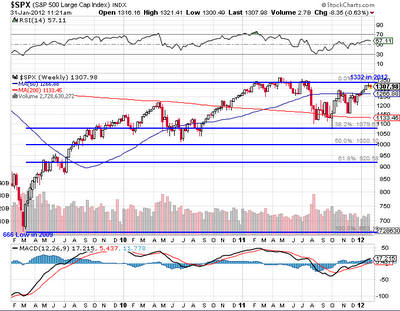
S&P Low 666 (2009) x 2 = High 1332 (2012)
| S&P Low in 2009 of 666 x 2 = 1332 High in 2012 |
The stock market has become a rigged game in the last few years. It is being propped up by the Federal Reserve and Ben Bernanke's team by printing unlimited dollars to buy futures and bonds in the open market. Bond prices are artificially low in order to encourage people to spend and not save. However, the smart people running big corporations are sitting on hoards of cash earning 0%. Its because the market has been propped up in a phony way and there is no organic growth. Executives are expecting a stock market crash of grand proportions that will wipe out all of the Government businesses that have been propped up. Cash will be king in the future and there will be no safe havens. It's just a matter of time before the huge "House of Cards" bonds and stocks all fall at the same tim,e wiping out the wealth that has been artificially created.
Yes, the United States can print endless amounts of money in order to create inflation and promote growth. The experts think we can grow our way out of the debt crisis and reduce the current 100% debt-to-GDP ratio that has doubled under the Obama administration. However, the austerity in Europe is nothing compared to what we might see in the U.S. if Mitt Romney gets elected and the Federal Reserve money printing press is halted. It will be painful in the short term but the long term gain for my kids and grandchildren will be tremendous. The U.S. Government must feel the pain of overspending and let the free markets take over their bloated and egregious spending habits. Don't forget Mitt Romney has been a private equity / restructuring guy in the private sector and will have the biggest turnaround project of all time on his hands once he pulls the Fed plug.
Mitt Romney knows that a healthy economy will grow through organic investment and capitalism at the local level. In healthy economies, the Venture Capital & Private Equity industries thrive and so do quality IPO's that foster the cycle of wealth that has built the foundation of the United States. However, the recent financial crisis has led the Government to step in and act as the market "Big Brother" to prevent big investors from losing money. The VC industry and private equity industries are shrinking drastically because large LP's (limited partners) have no incentive to invest with below 0% annual returns due to overbearing Government regulations. We all know in healthy free markets there are winners and losers. However, now the losers are being prevented from losing and this is not capitalism. Bailouts have been preventing huge bankruptcies and progress towards creating new and more efficient businesses.
Thousands of banks should have gone out of business and so should have many of the auto companies like General Motors. Restructuring and bankruptcies are all part of the free market cycle and we have yet to go through it on a large scale downturn. The 2009 downturn was prevented by the Government by double its debt load in the trillions and now the next recession could be even worse and deeper.
In summary the only thing that is going to help the economy in the long run build a foundation of growth that is sustainable is if the Government simply gets out of the way. We investors are all "Big Boys" and taking loses is part of the game. Trying to impose regulations on the financial services industry to prevent loses only restricts the free market capital flows and prevents investors from doing anything. We need investors to be excited about investing and now restricted. These two bills / laws need to be repealed by the next President and then you will see healthy organic investment growth come back to the private sector.
1) Repeal Sarbanes Oxley
2) Repeal Dodd Frank Bill
Popular Articles (All Time)
-
In the evolving landscape of digital media, publishers are constantly seeking innovative ways to monetize their content. One such tool that...
-
By Emily Cohn (Age 10) Are paper straws better for our environment than plastic straws? What do paper straws do in the world?
-
Credit card fraud has been a persistent issue for decades, affecting millions of people worldwide. Despite significant advancements in tech...
-
Geographic Information System (GIS) visualization techniques are essential for analyzing and presenting spatial data in meaningful ways. Her...
-
A Great Depression By 2025? - The Man Who Called The 2008 Recession Sounds The Alarm | Peter Schiff
-
Steve Blank shares an insider's perspective on how data and analytics are disrupting the art of venture capital investing . Is the era...
-
As we progress through 2024, the global financial landscape presents numerous opportunities for savvy investors, particularly in the realm...
-
When someone agrees to become a successor trustee , they often underestimate the commitment required. Acting as a trustee is not merely an ...